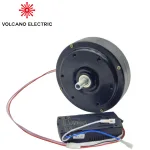
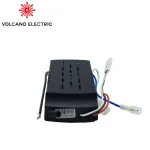
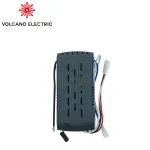
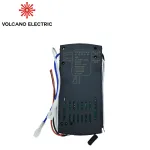
Product Specifications
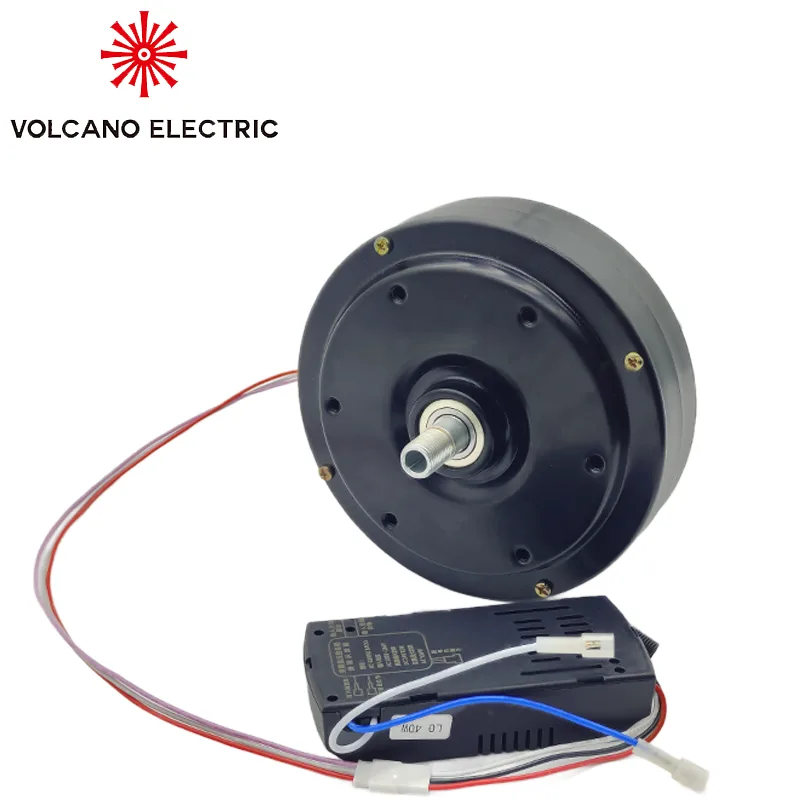
| Brand Name: | Volcano Electric | Model Number: | VOL-BL50B31 | Type: | Brushless DC Motor |
| Output Power: | 50W | DC Voltage: | 310V | Speed Range: | 600 RPM |
| Controller: | Customized, Optional | Braker: | none | Insulation Class: | Class F |
| Enclosure: | IP65 | Poles: | 16P | Wire: | 100% Copper Coil |
| Current: | 0.57A | Sensor: | none | Certification: | 3C, CE, UL |
| Housing: | Aluminum frame | Efficiency: | 90% | ||
| Duty: | S1, customized | Place of Origin: | Zhejiang, China (Mainland) | Standard: | ceiling fan motor |
| Application: | fan, ventilation | ||||
Product Description
In recent years, more and more ceiling fan manufactures are changing the induction motors into BLDC motors. BLDC motors which is Brushless DC motors convert more of the input power into useful mechanical outputs that turn the fan blades. Integrated controls allow wider range of precise speed control for better airflow and reduced energy use at lower speeds. Absence of brushes means less friction, wear & tear and higher durability with minimal maintenance needs. Brushless DC motors provides faster acceleration and deceleration with smooth speed regulation over full operating range. With less friction and no brushes to wear out, brushless motors can operate efficiently for 50,000 hours or more before requiring any major service.
In summary, the trends show brushless DC motors helping improve the end-user experience while lasting longer. Ceiling fan manufacturers can take advantage by offering more innovative and reliable products.
We insist that quality and honesty come first. Waiting for you and feel free to contact our team at info@volcanomotors.com for any technical support.
Configuration
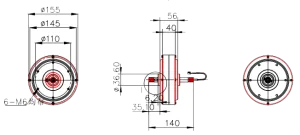
Brushless motor list
| Motor type | Output | Voltage | Load | Speed | Rated Torque | Poles | Efficiency | Noise |
| KW | V | A | RPM | N.m | % | dB | ||
| VOL-BL30C24 | 0.03 | 24 | 1.58 | 600 | 0.63 | 16 | 90 | 50 |
| VOL-BL30B24 | 0.03 | 24 | 1.6 | 600 | 0.6 | 16 | 90 | 50 |
| VOL-BL40C24 | 0.04 | 24 | 2.1 | 600 | 0.9 | 16 | 90 | 50 |
| VOL-BL50B31 | 0.05 | 310 | 0.57 | 600 | 1.3 | 16 | 90 | 50 |
Advantages of Brushless DC motors
- Lower Maintainance and longer lifetime – no brush and commutator erosion
- Lower electromagnetic noise -the elimination of brush contact
- Higher power to weight ratio
- Higher efficiency ( in general higher than 90%)
- Lower temperature rise – more efficient heat dissipation due to winding construction
- Simple structure
- Higher speed range- no limit of brushes and commutator
Customized Motors
For customized Motors, please contact our technician, Ordinary, we have to know the following information to get a professional proposal:
- Brushed or Brushless: Customer preference
- Output power (W): Horsepower/watts/torque rated at full load speed
- Voltage (V): i.e 12V DC …….. 450V AC
- Motor speed (RPM): Revolutions per minute of the shaft at full load Voltage
- Application: e.g. traction, air condition, etc.
- Duty: Most motors are rated continuous. Some applications however may use motors designed for intermittent duty
- Configuration/Frame: Our products are according to IEC standard, we also can customize the flange and shaft according to the customer drawing
- Controller function: e.g. forward/reverse, variable speed, acceleration profile, etc.
Application:
Ceiling fan motors play a crucial role in the operation of ceiling fans, providing the necessary power to rotate the fan blades and circulate air. Here are the main applications and functions of ceiling fan motors:
Air Circulation:
Cooling: The primary purpose of a ceiling fan is to circulate air in a room, creating a breeze that helps in cooling. The motor powers the rotation of the fan blades, which, in turn, moves air throughout the room.
Energy Efficiency:
Ceiling fans are known for their energy efficiency. They consume less energy compared to air conditioning units and can be used to supplement or even replace air conditioning in moderate climates. The motor’s efficiency is crucial in achieving this energy-saving feature.
Temperature Regulation:
Ceiling fans can help distribute both warm and cool air. In the winter, by running the fan in reverse (clockwise), warm air near the ceiling is circulated down to the living space.
Comfort Enhancement:
Ceiling fans contribute to the perceived comfort in a room. Even if the temperature isn’t reduced, the air movement created by the fan can make occupants feel cooler due to the wind-chill effect.
Ventilation:
Ceiling fans can also be used to improve ventilation by helping to expel stale air and bring in fresh air when windows are open. This is especially useful in rooms without proper cross-ventilation.
Aesthetic Enhancement:
Ceiling fan motors are designed to be aesthetically pleasing and are available in various styles and finishes to complement the interior decor of a room.
Lighting Integration:
Many ceiling fans come with integrated light fixtures. The motor not only powers the fan but may also control the lighting elements, providing both functionality and convenience.
Remote or Smart Control:
Modern ceiling fans often come with remote control or smart home integration, allowing users to adjust fan speed and settings. The motor is a critical component in enabling these advanced control features.
In summary, the ceiling fan motor is a central component that drives the rotation of the fan blades, facilitating air circulation, temperature regulation, energy efficiency, and overall comfort in residential and commercial spaces.